Showing posts with label book review. Show all posts

Sunday, September 9, 2018

The Ramona Series by Beverly Cleary (audiobook)


Image result for ramona quimby


Image result for ramona quimby

Ramona Quimby lives on Klickitat Street with her mother, father, and big sister, Beezus, and their old cat, Picky Picky. She's never afraid to try new things and is always up to something. I hadn't read the Ramona Quimby series since I was little, and I was thrilled at how well this classic children's series had aged. The conflicts and challenges of being a little sister and a new student and making friends are all still perfectly real. The idea of making tin can stilts is still deliciously intriguing to small ears. And in this audio version (all eight books for the price of one audiobook credit if you're an Audible member) is expertly narrated by Stockard Channing, who creates each voice and moment to perfection. I can't recommend this enough for a long car trip or just to keep on hand for carpool lines. It will have kids and adults spellbound for the entire set.

Includes:
Beezus and Ramona
Ramona the Pest
Ramona the Brave
Ramona and Her Father
Ramona and Her Mother 
Ramona Quimby, Age 8 
Ramona Forever
Ramona's World

Download it here: https://www.audible.com/pd/The-Ramona-Quimby-Audio-Collection-Audiobook/B0067QRF8Q

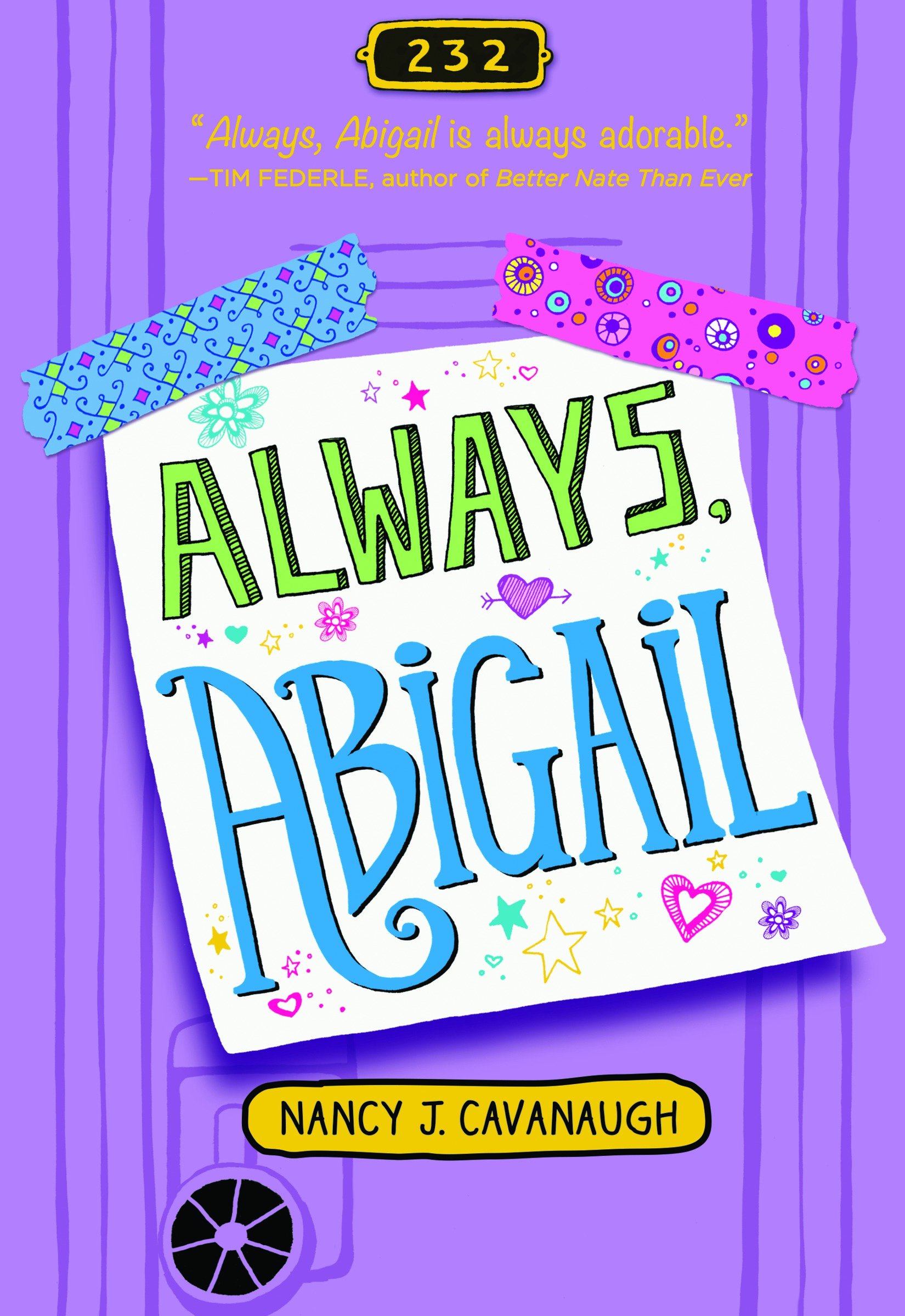
Always Abigail by Nancy Cavanaugh


Image result for always abigailIf you enjoy making and checking off a good list, this is a great book for you. A fun piece of Realistic Fiction, Always Abigail, is a SC Book Winner, written by Nancy Cavanaugh. It isn’t exactly a diary, it’s a list journal, or maybe you’d call it a listicle, written by sixth grader, Abigail Walters, to keep track of all the things she thinks are important (Pom Squad), awesome (her best friends, Alli and Cami), and terrible (her mean language arts teacher, The Hawk, and her uncool assigned class partner, Gabby Marco).
Abigail longs to join the Pom Squad and to be popular, but with Gabby Marco, she starts to develop a friendship that is more genuine than what she had with her supposed besties. I liked that Cavanaugh didn’t make it easier for Abigail to do the right thing, which happens in too many books and movies. Gabby did not get cooler or prettier or less weird. The perks of being a cheerleader did not fade. So yeah, by the end, Abigail’s struggle seemed genuinely hard. Abigail realizes some not so delicious things about herself, and I think it helps us recognize those opportunities in our own lives when we actually get to decide to “be better.”

Thursday, September 6, 2018

Bad news for outlaws: The remarkable life of Bass Reeves, Deputy U.S. Marshall


Nelson, V.M. with Christie, R.G. (2009) Bad news for outlaws: The remarkable life of Bass Reeves, Deputy U.S. Marshall. Minneapolis, MN: Carolrhoda Books

This rather more grown-up picture book outlines the life of Bass Reeves, from his childhood in slavery through his deputization by Judge Isaac C. Parker in 1875 and his methods of bringing in criminals. He escaped slavery after striking his master, and went west to live with the Native Americans. Because the west was so lawless, judges were instructed to deputize U.S. Marshalls, who were to bring in criminals dead or alive. Reeves, the only Black marshall, brought most of his over three thousand outlaws in alive, and not because he wasn’t a crackshot, but because he had such a strong moral compass. And because he was so wily.

Readers learn about some of Reeves’ more famous lawbreakers, and some of his more interesting methods of arrest, like impersonating outlaws or farmers. Nelson does a nice job combining facts with storytelling, which makes Reeves seem as exciting but more real than some Western tall tales. There is a photo of Reeves in the back, with his trademark bushy moustache and imposing gaze, as well as a glossary of some of the fun western words like “dry-gulch” and “shooting irons.” Some of the more serious words, like “warrant” and “lynching,” are included, which I’d already had to explain (badly) for my seven year old. The end notes also offer a timeline of both the country and Reeves’ exploits, and some further reading and websites, info on Judge Parker and Indian Territory and her bibliography. These last I may be able to use for one of my summer camps for the library, as I look for western stories and frontier life! The artwork is a good accompaniment to the stories with a “cruder” folk style evocative of a hard, dry country teeming with two-legged varmints. They actually worked very well telling a story about rustic frontier life.

Balloons over Broadway


Sweet, M. (2011). Balloons over Broadway. New York, NY: Houghton Mifflin Books for Children.

Tony Sarg was the puppeteer who made the Macy’s Thanksgiving Day Parade such a visual treat. The story begins with his first invention, a chicken feeder that allowed the six year to feed his father’s hens without leaving the comfort of his bed. Sarg went on to become a puppeteer in London, and then in New York City, where he earned the admiration of R.H. Macy, who asked him to design mechanized marionettes for his holiday window displays. An immigrant, Sarg wanted to created spectacular puppets for the holiday parades celebrated by New York’s immigrants, and Macy agreed to put on a parade for his employees. The story follows Sarg on his journey from small puppets on floats, to larger rubber stick puppets, to giant helium and silk puppets that everyone could see for miles.

I love it when non-fiction books are approachable for children. Every kid loves puppets and parades, and so this is a more entertaining read than some. It does educate, but as much about the man as about how something works. And no kid could possibly look at those enormous balloon puppets and not wonder how they work and what they’re made of. It’s a good Wonder to tackle!

The author made her own toys and puppets to make the illustrations for this book. She made collages of watercolors, papier-mache puppets made from old books, fabrics, and found objects, which she painted and altered to take readers into the world and mind of Tony Sarg. I liked the mixed media feel of this book, like we are exploring shapes and dimensions in the same way Sarg must have experimented trying to make puppets in reverse and on a grand scale. The book contains a Bibliography and Sources section, a Quotes Sources space, as well as notes about Sarg that she discovered that didn’t make it into the story. Sweet thanked the friends, families and institutions that assisted her in her research. Even the paper lining is of old newspaper clippings of early Macy’s parades and book mentions of Sarg. All in all, this book is playful—the colors, the artwork, the text. It’s so important for a kid to see how artistic expression, experimentation and determination can become something iconic and wonderful.

I get so hungry


Campbell, B.M. with Bates, A. (2008). I get so hungry. New York, NY: G.P. Putnam’s Sons


This book tackles the national epidemic of obesity in children, through the eyes of Nikki, a young African-American girl. Her classmates tease her about her weight, calling her Supersize and Nikki Thicky. She has always relied on food to make herself feel better and when she starts, it’s hard to stop. It’s a family problem too, despite the pediatrician’s advice. When her overweight teacher, Mrs. Theodora Patterson, has a scare and starts to work for a healthier lifestyle, Nikki takes note. Her teacher drinks water and stops sneaking food. She walks to work and around the schoolyard between classes. Instead of reaching for the chips that night, Nikki asks her mom if it’s okay to walk with Mrs. Patterson before school. Her teacher tells her she is eating more healthy food, so she doesn’t get hungry throughout the day. Nikki’s mom is impressed by Mrs. Patterson’s weight loss and decides to walk with her daughter on weekends. By the start of the new school year, Nikki is healthy and no longer food dependent.

I don’t think I’ve ever read a children’s book about obesity before. I’ve seen books about mobility, diabetes, ELL students, and cancer, but this book intrigued me. Yes, it’s a bit simple. Food dependence is hardly solved in a fifty page children’s book. But this book is a mirror, and I think it’s a great idea to devote some time to a topic that is so affecting our population of children. It is surprisingly unpreachy or moralizing. The little girl is loved and cared for, but a bit in the wrong way. Her mom soothes a sad doctor’s visit with a trip to the doughnut shop. You know it’s bad, but there’s no finger shaking or scolding. And I liked that while obesity can have a snowball effect in a family, healthier living can as well. Mrs. Patterson’s commitment to the simple act of walking was contagious, getting a student and then her mother outside and moving. The watercolor and ink illustrations are lovely, very fresh and uncluttered/ She does draws expressions wonderfully, a downcast eye, a thrust out lip. And her characters have an inner glow and a softness that make them seem infinitely accessible and sympathetic. It reminds me of Marla Frazee’s work, similar to All the World. While this book isn’t necessarily worthy of an award, I think it’s a great toe-dip into a subject that needs more books. More children struggling with obesity deserve to know they are not alone in their fight. They deserve inspiration and characters that look and think like them and work hard and are rewarded. More of this, please.

A Bear called Paddington (Audiobook)


Bond, M. narrated by Fry, S. (2005). A Bear called Paddington [audiobook]. 

Narrated by Stephen Fry of Jeeves and Wooster hilarity, this book is marvelous. Fry does different voices for Paddington, the Browns, Mrs. Bird, Mr Curry and Mr Gruber, even the shopkeepers and bobbies. The pacing and clear diction are easy to understand, even for small children who aren’t used to accents. And his comic timing is perfect. There were peals of little boy laughter from the backseat every time the Browns said, “Oh dear,” or Paddington gave someone “a hard stare.” The other volumes narrated by Hugh Bonneville are also excellent. After we finished the first, both the eight year old and the three year old wanted more, which is a good sign!

Checking the physical book out of the library was just as great a pleasure. Bond’s pencil drawings are darling, and it is always nice to see how an author has pictured his character in his own mind. Paddington looks charmingly disreputable sitting on the train platform with his suitcase, battered hat and his note, “Please look after this bear.” The image of him upsetting the table of buns is pure magic. With its mixture of pictures and short, clear sentences, I think this would be appropriate for a child ready to graduate from Cynthia Rylant or Emily Jenkins’ Toys Go Out and then Paddington. There are some vocabulary differences, between American English and British English, but these can generally be figured out by context. 

Retrieved from http://www.audible.com/pd/Kids/A-Bear-Called-Paddington-Audiobook/B002V0QQ7S/ref=a_search_c4_1_1_srTtl?qid=1490320295&sr=1-1

The book with no pictures


Novak, B. J. (2014). The book with no pictures. New York, NY: Random House.
Similar to Elephant and Piggie’s We Are In A Book, Novak’s The Book with No Pictures makes the reader break the fourth wall. The reader must say everything written on the page, even if it’s “I am a robot monkey,” or “Glibbity globbity.” The reader has to sing and make goofy noises and proclaim herself to be “a robot monkey” complete with a silly techie font. The adult reading aloud has to beg to stop reading, and the children listening presumably get a chance to yell, “No!” 

Even without pictures, the book is funny with a lot more interaction between grownups and children than traditional books. There is a smidge of potty humor, entertaining use of fonts, and tons of laughter. This is a great readaloud book for children PreK through second grade.

Zen Shorts


Muth, J.J. (2005). Zen Shorts. New York, NY: Scholastic Press.

This picture book is the story of how three children, Addy, Michael and Karl meet a Zen-master panda bear named Stillwater. Stillwater moves in next door, and each child comes to him with different philosophies, problems or worries, and to each, he gives them a Zen story that puts things in a new perspective. To Addy, who bakes him a cake, he tells the story of a poor man who gives gifts to a robber. To Michael, who is a worrier, he tells a story of a farmer who knows that good luck and bad luck are all a matter of perspective. And to Karl, who is the youngest and holding on to hurt feelings, Stillwater shares the story of “The Heavy Load,” and encourages him to put down his burdens to make room for lighter feelings.

Having shared this book at a first grade readaloud, I found that this age group of six and seven year olds had a lot to share about the stories and pictures. They found the story of Uncle Ry wishing he could give the robber the beautiful moon very romantic. Several agreed that putting down injustices was something they probably needed to work on, just like Karl and the young monk from “The Heavy Load.” Even the students who had read the book before hadn’t noticed the calligraphy in “The Farmer’s Luck.” They really got a discussion going, which I thought was remarkable. I personally love this book because for any age group, it’s helpful to have a short meditation that helps make “different” sense out of our situations. I know I can hold on to blame like a dog with a bone, and the admonishment of the old monk, “Why are you still carrying her?” hits home whenever I think on it.

Jon Muth’s illustrations are not necessarily detailed, but somehow he still captures the essence of expression; no one looks more quietly annoyed than Stillwater with a pool full of sharks and floaties. Muth said, “I love stories. I love what language does. It’s the finger pointing at the moon, the truth. That’s what my pictures have to do as well” (Marcotte, 2015). His watercolors of the children and the panda bear playing together create soaring treescapes and hilarious wading pool scenarios (Stillwater wears fat pants!). Stillwater’s stories though, are done in ink brushwork, calligraphy trees and landscapes with cartoonish animals enacting the short Zen story. I think it could be a fun book to drop into a curriculum about religions, mindfulness, calligraphy art class, Chinese or Japanese culture…it’s very versatile.

Reference
Marcotte, A. (2015). Zen and the art of Jon Muth. “American Libraries. Retrieved from https://americanlibrariesmagazine.org/blogs/the-scoop/zen-and-art-jon-muth/

One morning in Maine


McCloskey, R. (1980). One morning in Maine. New York, NY: Penguin Books.

A sequel to Blueberries for Sal, this book, also a Caldecott winner, follows Sal on her next adventure—a loose tooth. At first alarmed and scared she will miss out on a trip to Buck’s Harbor with her dad, her mother comforts and reassures Sal that it is part of being a big girl to lose a tooth. She can put the tooth under her pillow and make a wish. Walking down to meet her father, Sal tells all of the Maine animals about her loose tooth—the drawings are breathtaking—from a fish hawk to a curious seal. She helps her father dig for clams and her tooth falls out into the pebbly sand. I think the most poignant line of the book is when Sal makes a face “that is almost like crying.” She ends up making a wish on a feather a gull lost instead, and her baby sister makes a wish on a spent spark plug, and both girls get an ice cream cone—their wishes come true.

The rooster crows: A book of American rhymes and jingles.


Petersham, M. & Petersham, M. (1945). The rooster crows: A book of American rhymes and jingles.
New York, NY: Simon & Schuster, Inc.

A collection of traditional American nursery rhymes, The Rooster Crows includes finger games, skipping rhymes, songs, jingles, and counting rhymes from all over America. From “Engine, Engine, Number Nine” to “This Little Pig,” to the now less familiar “Entry Kentry Cutry Corn,” there are many favorite rhymes that form a part of America’s cultural heritage, or, as the book jacket says, “An American Mother Goose.” The clothing and scenes are reminiscent of a more pastoral time, old fashioned, yet comforting and still familiar. The four color illustrations are beautifully rendered and charmingly humorous.

The stinky cheese man and other fairly stupid tales.


Scieszka, J. & Smith, L. (1992). The stinky cheese man and other fairly stupid tales. New York, NY: Viking Press.

This collection of fractured fairy tales presents absurdly recreated versions of traditional stories, such as The Stinky Cheese Man in lieu of The Gingerbread Man. Hugely comical drawings by Lane Smith alert young readers to the ridiculousness of the storylines, with eye-popping cows overcome by the smell of a little blue-cheese man, an ugly duckling who grows up to be an ugly duck, and the Giant from the beanstalk eats the little red hen. Scieszka breaks the fourth wall, referring readers back to the table of contents, making fun of the copyright info, and adding types of fonts and disappearing text to involve the reader directly in the craziness of the stories and even the book itself. Similar to Novak’s Book with No Pictures, this allows readers to be in on the joke and the silliness.

Smoky night


Bunting, E. & Diaz, D. (1994). Smoky night. San Diego, CA: Harcourt Brace and Co.

Against the backdrop of the LA riots, Bunting tells the story of Daniel and his mom, Gina, who are forced to leave their home during the tumult. They witness looting and violence, and their apartment building is set on fire. The social strife is handled delicately, and most of the tension is approached through the tension of Daniel’s missing cat. The story also shows how a neighbor, Ms. Kim, is displaced, and we learn that there is racial conflict between Gina and Ms. Kim, which is ultimately overcome through shared worry about pets and an awareness of similar struggle. Diaz’s illustrations—acrylic painting over collage—creates a dramatic backdrop to a story about cultural strife, racism, community, and communication.

Mufaro’s beautiful daughters: An African tale


Steptoe, J. (1987). Mufaro’s beautiful daughters: An African tale. New York, NY: Lothrop, Lee, & Shepard.

This picture book is an East African version of Cinderella, with a bad sister, Manyara, and a good sister, Nyasha. Imbued with the virtues of kindness, generosity and humility, young readers will anticipate the rich rewards in store for goodness, and the punishment meted out for mean-spiritedness. The tale has all the important universal characteristics of a good fairy tale, with enchanted forests, shape shifters, and a handsome king at the end. 

I love the lush illustrations painted by Steptoe, which, like Pinkney’s Aesop’s Fables and Sharon Robinson and Kadir Nelson’s Testing The Ice, are rich stories on their own, but become absolute treasures combined with artistic illustrations. Steptoe’s work is a more impressionistic than, say, Nelson, but both Black illustrators have painted portraits that add humanity and diversity to stories with fairly universal themes. Steptoe’s paintings are almost romantic in style, exploding with flowers, lavish, with positive figures seemingly lit from within. It is an almost Renaissance-style visual journey laid over an African folk tale. 

I admire the author-illustrator, because he wanted Black children to feel proud of who they were.
"People sometimes send me questionnaires asking me who influenced me, what books I read. But I wasn't influenced by anybody. The Hardy Boys? How is that going to inspire me? What I'm saying is that black folks don't have anybody to inspire them…I think it's more important for me to write books that may present ideas to very young people…What I try to create are all the things I didn't have as a kid that I would have liked to read." (Natov & Deluca, 1987, p. 126)

The art from this story could so easily be added to Cinderella or Snow White, princessy-themed stories European-American children are used to reading. The motifs of the story are known: the bad sister gets her comeuppance while the kind sister is rewarded with a prince/king. But with African names and beautiful black features, these characters are fresh while still relatable. It’s an interesting segue for children into the genre of African folk tales. Steptoe gives readers something they are accustomed to—the experience of magical fairy tales—but with the opportunity to see something new.

Reference: Natov, R. & DeLuca, G. (1987). An Interview with John Steptoe. The Lion and the Unicorn, 11(1), 122-129.